2,400 years ago the dangerous new technology was parchment, and the argument against it was word for word the argument against AI today
Socrates hated books. Just as people today hate AI.
The philosopher Socrates (470-399 BC)1 sincerely believed that books (written language) would:
- destroy the human mind,
- create an illusion of knowledge,
- and lead to total forgetfulness.
Socrates claimed that writing and reading are a disaster for the human brain.
This invention will breed forgetfulness in the souls of those who learn it, since they will cease to exercise their memory.23
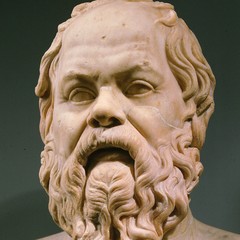 Socratesin Plato's Phaedrus 275aHerm of Socrates, Capitoline Museums
This is a literal parallel to today's argument that "because of AI, people will forget how to think."
The ancient Greeks' fear of a piece of parchment and white-collar professionals' fear of LLMs is a fear of progress. Technology doesn't make us dumber; it SCALES our capabilities.
I recently read the non-fiction book "Moonwalking with Einstein. The Art and Science of Remembering Everything" by Joshua Foer6. One of the book's main characters is Ed Cooke, a British memory champion and the creator of the Memrise app7.

I became curious about what he's doing in 2026. It turns out Ed is working on an AI service called MindMax Labs8 (https://mindmax.it/). Their goal, inspired by Goethe's ideas, is to turn every person into a genius with the help of AI.
On the page, I found a great video (see screenshot) that perfectly illustrates the historical irony with Socrates.
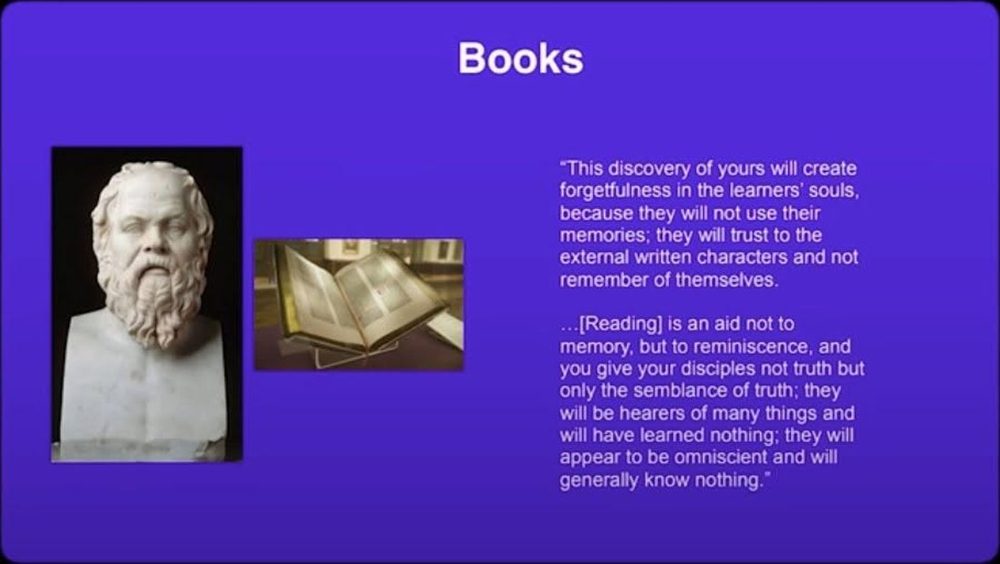
Criticism of AI is criticism of books, version 2.0. We aren't losing the ability to think with Claude/Gemini/ChatGPT; we're UPGRADING our cognitive operating system.
References
- Socrates, Stanford Encyclopedia of Philosophy - on the dates, and on the fact that Socrates wrote nothing himself - https://plato.stanford.edu/entries/socrates/↩
- Plato, Phaedrus, 274c-275b, trans. Benjamin Jowett - the myth of Theuth and Thamus, where the objection to writing is made - https://www.gutenberg.org/ebooks/1636↩
- Plato, Phaedrus, trans. H. N. Fowler, Loeb Classical Library, Plato in Twelve Volumes, Vol. 9 (Harvard University Press, 1925)↩
- Wegner, D. M., Transactive Memory: A Contemporary Analysis of the Group Mind, in Theories of Group Behavior, ed. B. Mullen and G. R. Goethals (Springer, 1987), 185-208 - https://doi.org/10.1007/978-1-4612-4634-3_9↩
- Sparrow, B., Liu, J. and Wegner, D. M., Google Effects on Memory: Cognitive Consequences of Having Information at Our Fingertips, Science 333:6043, 776-778 (2011) - https://doi.org/10.1126/science.1207745↩
- Foer, J., Moonwalking with Einstein: The Art and Science of Remembering Everything (Penguin, 2011)↩
- Memrise - the language app Cooke co-founded - https://www.memrise.com/↩
- MindMax - the service Ed Cooke is building - https://mindmax.it/↩