Two results landed within weeks of each other. Separately they are interesting. Together they are harder to dismiss, because they narrow the same gap from opposite directions.
One — a global workspace inside the model
On 6 July 2026, Anthropic's interpretability team published Verbalizable Representations Form a Global Workspace in Language Models. The method is a new tool called the Jacobian lens, or J-lens, which identifies internal representations that are verbalizable: poised to be spoken about, should the occasion arise, as distinct from those that merely happen to be spoken about in one particular context. The averaging step is what makes the distinction possible.
What they found is that this set does considerably more than support speech. It behaves like a global workspace: the small privileged buffer that cognitive science has long used to describe the contents of a mind that are available to report and to reasoning. The representations in this space, which the team calls J-space, are reportable, steerable, used in internal reasoning, broadcast widely, and not required for automatic processing.
Two numbers keep this honest. J-space carries under ten per cent of activation variance and holds on the order of twenty-five concepts at a time, and it appears only in the middle block of the network. It is a thin slice, not the whole model.
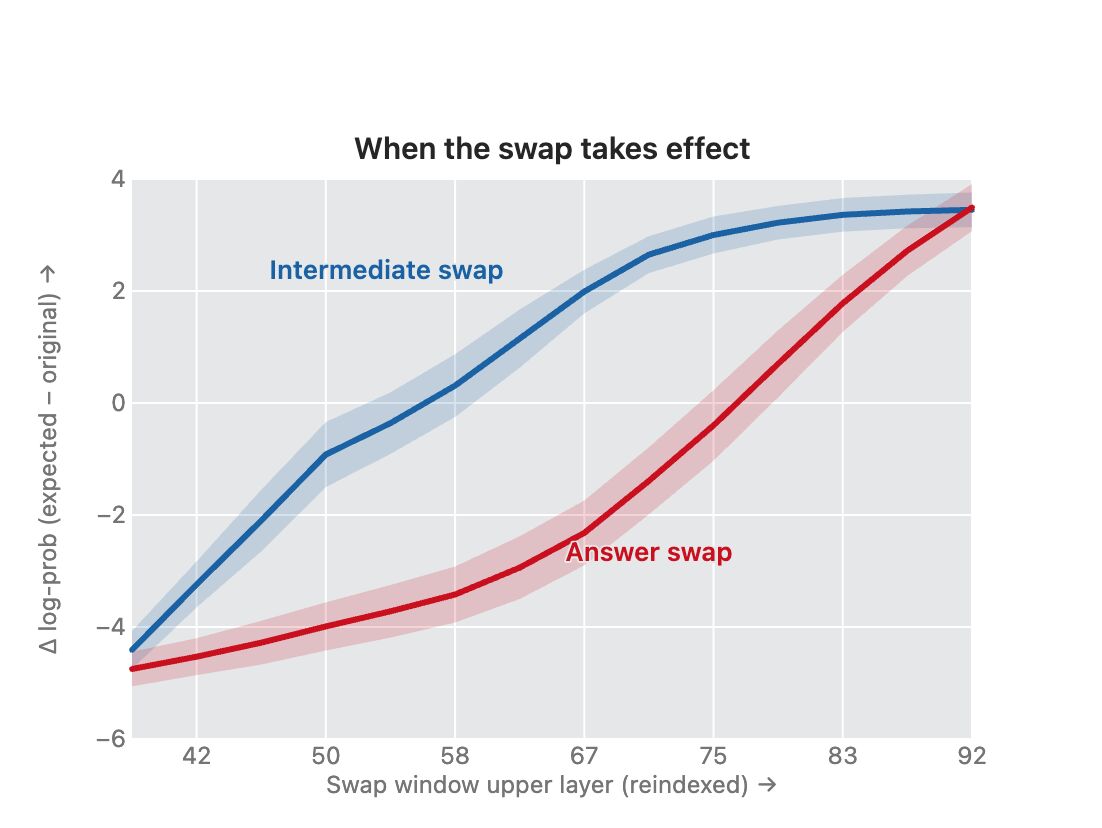
It is also not the chain of thought you see in a chatbot. It is a layer underneath, made of concepts the model is holding and operating on without writing them down.
Here is where the reporting went wrong, my own first reaction included. This is not evidence of subjective experience. The paper's claim is narrow and falsifiable: a privileged subspace exists that satisfies the functional criteria Global Workspace Theory sets out for conscious access. Functional access, not phenomenal experience. The distinction is the entire argument, and collapsing it is how a careful result becomes a bad headline.
What it does give us is practical: a place to look. If a model is tracking something it has not said, that a user appears to be probing it for example, this is where you would expect that to be legible.
Two — language prediction in an unconscious brain
On 6 May 2026, Nature published Plasticity and language in the anaesthetized human hippocampus by Kalman Katlowitz and colleagues at Baylor College of Medicine in Houston.
Seven patients undergoing epilepsy surgery had Neuropixels probes placed in the hippocampus: high-density microelectrodes that record hundreds of individual neurons, not an average across a population. While the patients were under general anaesthesia, the team played them tones, and then clips from educational videos and storytelling podcasts.
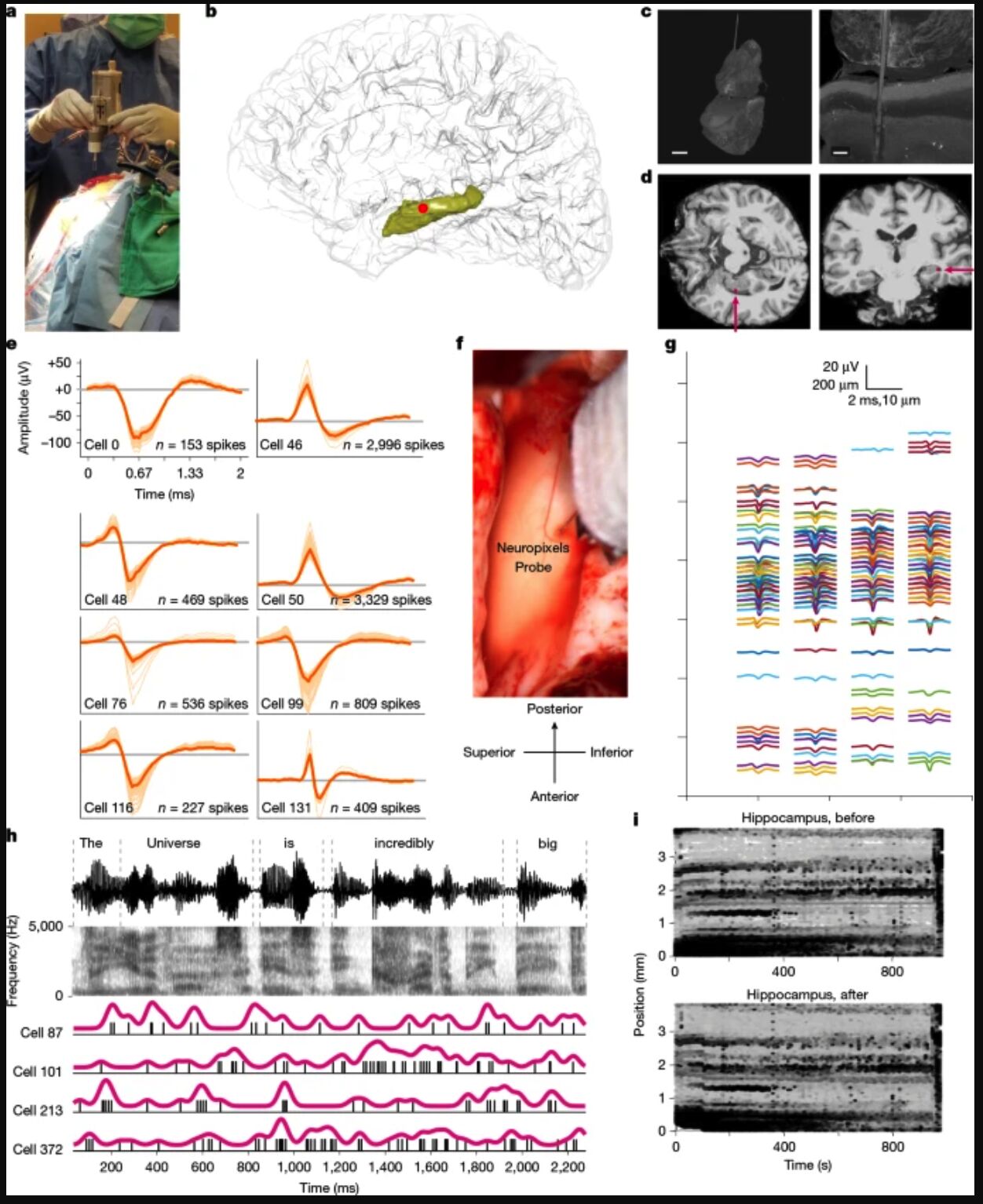
The unconscious hippocampus discriminated oddball tones, and the effect grew over roughly ten minutes of the experiment. That is representational plasticity: learning, without awareness. In the language phase, neural firing patterns distinguished parts of speech and showed evidence of anticipating upcoming words.
Predictive coding of the kind we associate with being awake and attentive, occurring in a state with no awareness, no memory and no capacity to act.
Why they belong on the same page
One result finds a reportable, reasoning-adjacent workspace inside a system built on next-token prediction. The other finds next-word prediction running in a biological system that has, at that moment, no consciousness at all.
The convenient position, that prediction is what machines do and understanding is what minds do, gets squeezed from both sides. Neither paper claims to resolve it. Both make the question sharper, which is the more useful outcome.
References
- Gurnee, W., Sofroniew, N., Pearce, A., et al., Verbalizable Representations Form a Global Workspace in Language Models, Transformer Circuits Thread, Anthropic, 6 July 2026 — https://transformer-circuits.pub/2026/workspace/index.html
- Anthropic, A global workspace in language models, research summary — https://www.anthropic.com/research/global-workspace
- Katlowitz, K. A., et al., Plasticity and language in the anaesthetized human hippocampus, Nature 654, 714–723 (2026) — https://doi.org/10.1038/s41586-026-10448-0
- Even the unconscious brain can learn — and predict what you'll say next, Nature news, 6 May 2026 — https://www.nature.com/articles/d41586-026-01465-0
- Baars, B. J., A Cognitive Theory of Consciousness (Cambridge University Press, 1988) — the original statement of Global Workspace Theory