The word we are currently using for the 2020s will probably not be the word history uses. That is not a prediction about the decade. It is an observation about how naming works, and the current case is unusually well documented, because we can watch the label wobble in real time.
Where the term actually comes from
Polycrisis was coined by Edgar Morin, the French philosopher of complexity, with Anne-Brigitte Kern, in Terre-Patrie (Seuil, 1993). The English translation, Homeland Earth: A Manifesto for the New Millennium, followed in 1999, which is why the date is often reported wrongly. One book, two years.
Their formulation was planetary and structural. There is no single vital problem, they argued, but many, and it is the complex intersolidarity of problems, antagonisms, crises and uncontrolled processes that constitutes the vital problem.
Then the term sat almost unused for two decades.
The European Commission put it into policy language
The step most accounts skip is the one that matters most institutionally. In 2016, Jean-Claude Juncker, then President of the European Commission, adopted the word to describe a combination of crises facing the European Union at the same time and in ways that fed each other: security threats in the neighbourhood and at home, the refugee crisis, and the United Kingdom referendum.
Juncker's usage differs from Morin's in a way that is easy to miss and consequential. Morin described a single planetary condition. Juncker described a specific, bounded, governable situation, which leaves the door open to the idea that there can be several smaller polycrises at once. Scholars of the EU picked the term up from him almost immediately.
So the sequence is Morin 1993, Juncker 2016, Davos 2023. The word entered policy vocabulary through a European institution six years before it became a conference buzzword.
Then the historian, and then the doubt
Adam Tooze is the person most widely credited with popularising it, after a prominent segment at Davos in 2023. His version is planetary like Morin's, not bounded like Juncker's, but he dates the beginning of the global polycrisis to around 2008, where Morin and Kern placed it decades earlier.
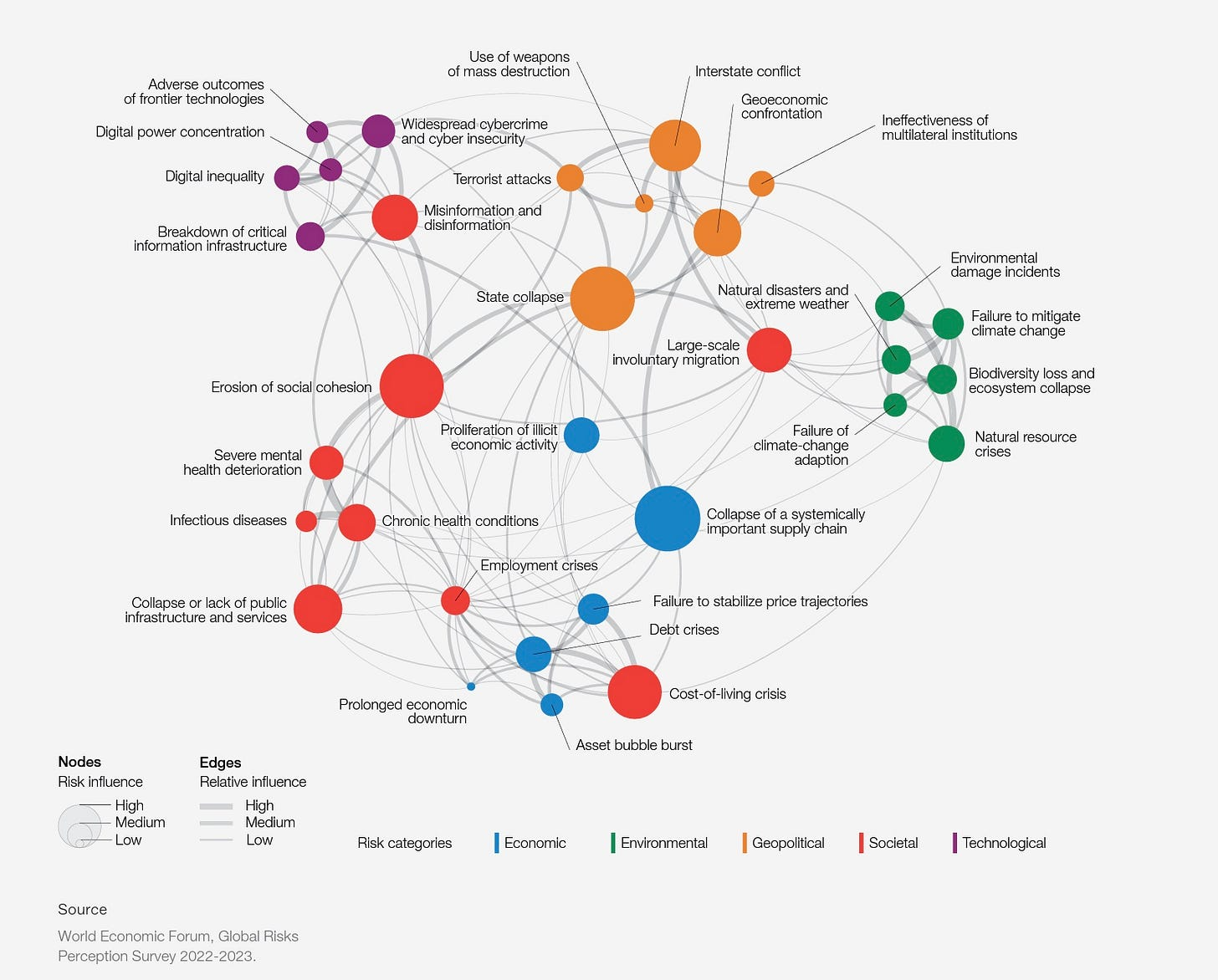
The Davos version of the word arrives with a picture attached, and the picture is doing a lot of the persuading: thirty-odd risks, five colour-coded categories, and a thicket of edges between them. It is a good illustration of entanglement. It is not evidence of a period.
Note what that means. Three serious users of the same word disagree about when the thing it names began, by margins of fifteen years and more. A term whose referent has no agreed start date is not yet a historical period. It is a mood with a vocabulary.
And then, in September 2025, Tooze himself began to have second thoughts about whether polycrisis still made sense. If everything is going to hell, he asked, why have the markets stayed eerily calm? Where, in other words, is the crisis?
That is the empirical hook. We are not speculating about whether the label will survive. We are watching the person who popularised it examine the joins.
The pattern is not new
People do not name the period they are living through. They name what they are experiencing, and experience is a poor guide to what a period turns out to have been.
The First World War was the Great War for most of its duration, and the war to end war after H. G. Wells attached the phrase. Nobody numbered it, because numbering implies a sequel. The ordinal appears in Charles à Court Repington's account of the conflict, published in 1920 as The First World War 1914–1918 — a title chosen, by his own account, in the gloomy expectation that another would follow. He was naming it against the mood of the moment, and he was right.
The second one was named faster, and differently in different places. In the Soviet Union it became the Great Patriotic War from June 1941, a name for a war of national survival, not for a global sequence. In the United States it settled as World War II. Two names for overlapping events, each encoding what the naming country thought the war was about.
Which is the point. A period's name is not a description of its contents. It is a compression of its outcome, applied afterwards, by whoever ends up doing the compressing.
What the 2020s might end up called
If the decade resolves into a wider war, the current vocabulary vanishes and the period gets an ordinal, exactly as 1914 did. If it resolves into economic and institutional fragmentation, something like deglobalisation is the likely label. If artificial intelligence turns out to be the dominant variable, the decade becomes a prologue and gets named for what followed. And there is the Great Unravelling, already in use among ecologists, which happens to describe the simultaneous loosening of institutions, alliances, climate stability and informational consensus rather well.
I have no idea which. Neither does anyone else, and that is the argument.
Why this belongs in a research notebook rather than a comment page
There is a methodological consequence, and it is not abstract for anyone working on information integrity.
If a period cannot be named from inside it, then every real-time frame applied to ongoing events is provisional. That includes the frames we use for influence operations, platform failures and institutional decay while they are happening. The categories we are currently using to sort what is going on are the equivalent of calling it the Great War in 1916: useful, sincere, and probably not what it will be called.
The practical discipline that follows is to hold the frame loosely and the evidence tightly. Date things. Cite things. Describe mechanisms, not eras. Mechanisms survive renaming; eras do not.
References
- Morin, E., Kern, A.-B., Terre-Patrie (Éditions du Seuil, 1993); English translation Homeland Earth: A Manifesto for the New Millennium (Hampton Press, 1999)
- Lawrence, M., Homer-Dixon, T., et al., Global Polycrisis: The Causal Mechanisms of Crisis Entanglement, Cascade Institute — https://cascadeinstitute.org/technical-paper/global-polycrisis/
- Economic Globalization's Polycrisis, International Studies Quarterly 68(2), sqae024 (2024) — on the term's origins, Juncker's 2016 usage, and Tooze's divergent dating — https://academic.oup.com/isq/article/68/2/sqae024/7634048
- World Economic Forum, Global Risks Report 2023 — the polycrisis risk-interaction map — https://www.weforum.org/publications/global-risks-report-2023/
- World Economic Forum, This is why 'polycrisis' is a useful way of looking at the world right now — interview with Adam Tooze, March 2023 — https://www.weforum.org/stories/2023/03/polycrisis-adam-tooze-historian-explains/
- Repington, C. à C., The First World War 1914–1918 (Constable, 1920) — the earliest widely cited use of the ordinal
- More than a buzzword? Mapping interpretations of the 'polycrisis', Sustainability Science (2025) — https://link.springer.com/article/10.1007/s11625-025-01790-9