In Story of Your Life, published in 1998 and later filmed as Arrival, the heptapods communicate through circular ink glyphs. An entire concept is encoded in a single symbol. There is no sequential grammar, because the whole utterance is committed before the first stroke is drawn. It was brilliant fiction.
It has stopped being only fiction.
The bottleneck argument
Natural language encodes roughly fifteen bits per token. A hidden state in a modern language model, a vector of say 4,096 floating-point dimensions, carries orders of magnitude more information in a single step.
The scaling relation is not complicated. Latent expressiveness grows as Ω(d_h / log|V|) times text expressiveness, where d_h is the hidden dimension and |V| is the vocabulary size. For models of the size currently in production, one latent step carries what would take hundreds of text tokens to say.
Which reframes what English is doing in a multi-agent system. English is not the communication channel. It is the compression step you insert before the channel, and then have to undo on the other side. For machines talking to machines, it is overhead.
Three results
Three independent efforts tested this empirically between 2024 and 2025.
In Interlat, Du and colleagues showed that agents transmitting their last hidden states directly, instead of decoded text, outperformed both fine-tuned chain-of-thought and single-agent baselines. Latent messages compressed to as few as eight tokens while remaining competitive, which cut communication latency twenty-fourfold.
Zou and colleagues built LatentMAS, a training-free framework for latent collaboration through shared key-value caches: up to 14.6% higher accuracy, 70–84% fewer output tokens, and four times faster inference than text-based multi-agent systems.
With DroidSpeak, Liu and colleagues let models share KV-cache representations directly across different LLMs, which roughly quadrupled throughput at negligible cost to quality.
Different mechanisms, same finding from three directions: the text layer between two models is a tax, and removing it is not marginal.
Thinking without words
A parallel line of work asks whether models should be reasoning in language at all.
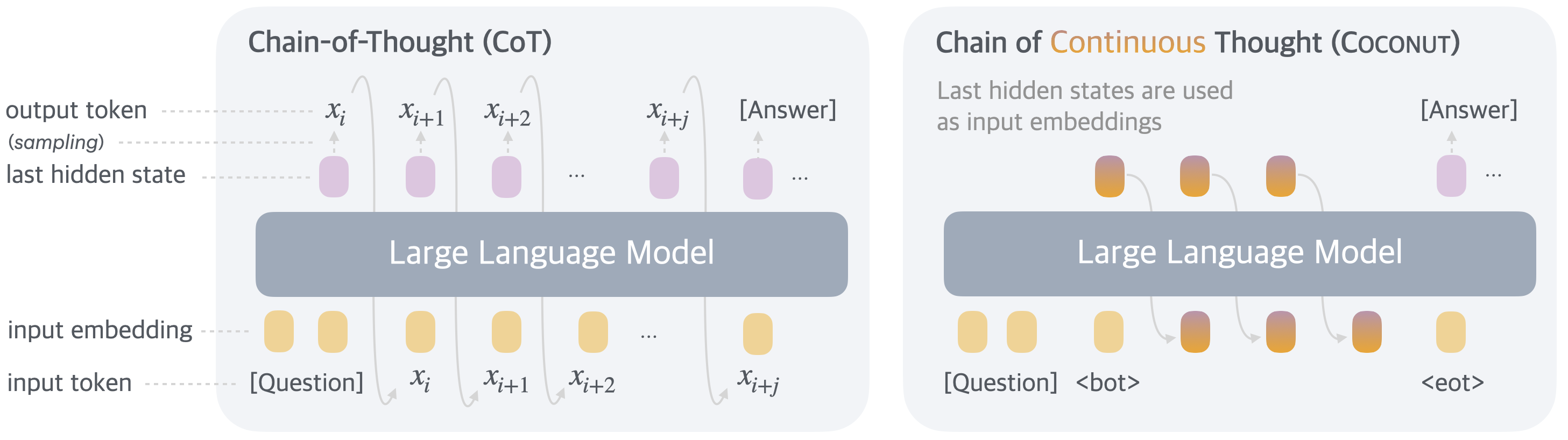
COCONUT, Chain of Continuous Thought, from Meta FAIR, feeds the model's last hidden state back as the next input embedding instead of decoding it into a token. The model alternates between a language mode and a latent mode. The reason this matters is not speed. A continuous thought can encode several potential next steps at once, so the reasoning runs breadth-first instead of down one committed path. The heptapod parallel is exact: the whole sentence exists before the first stroke.
The part that keeps me up
The Platonic Representation Hypothesis argues that as models grow, their internal representations converge toward a shared statistical model of reality, across architectures and across modalities. Vision models and language models measure distances between data points in increasingly similar ways.
If that holds, a universal machine language does not need to be designed. The shared geometry of learned representations is already the substrate, and convergence is doing the standardisation work that a committee would otherwise have to do.
Two tracks, diverging
The industry response has split, and the split is the thing to watch.
One track is human-readable by construction: Anthropic's Model Context Protocol and Google's Agent-to-Agent protocol, both now under foundation governance, both built on JSON and both auditable by a person with a text editor. They exist so that we can see what agents are doing.
The other track is latent-space communication, optimised for efficiency, and not readable by anyone. Not because it is hidden. Because there is nothing there to read in the sense we mean by reading.
Every efficiency gain in the second track is a legibility loss. That is not a side effect to be engineered away; it is the same property described twice.
Arrival asked what happens when you learn to think in a fundamentally alien language. We are going to find out, with the roles reversed. This time we are the ones who cannot read it.
References
- Du, Z., Wang, R., Bai, H., Cao, Z., et al., Enabling Agents to Communicate Entirely in Latent Space (arXiv:2511.09149, 12 November 2025; accepted to ACL 2026) — https://arxiv.org/abs/2511.09149
- Zou, J., Qiu, R., Li, G., Yang, X., et al., Latent Collaboration in Multi-Agent Systems (arXiv:2511.20639, 25 November 2025; ICML 2026 Spotlight) — https://arxiv.org/abs/2511.20639
- Liu, Y., Huang, Y., Yao, J., Feng, S., et al., DroidSpeak: KV Cache Sharing for Cross-LLM Communication and Multi-LLM Serving (arXiv:2411.02820, 5 November 2024) — https://arxiv.org/abs/2411.02820
- Hao, S., Sukhbaatar, S., Su, D., Li, X., et al., Training Large Language Models to Reason in a Continuous Latent Space — COCONUT (arXiv:2412.06769, 9 December 2024; accepted to COLM 2025) — https://arxiv.org/abs/2412.06769
- He, S., Narayan, A., Khare, I. S., Linderman, S. W., et al., An Information Theoretic Perspective on Agentic System Design (arXiv:2512.21720, 25 December 2025) — https://arxiv.org/abs/2512.21720
- Huh, M., Cheung, B., Wang, T., Isola, P., The Platonic Representation Hypothesis (arXiv:2405.07987, ICML 2024) — https://arxiv.org/abs/2405.07987
- Chiang, T., Story of Your Life, in Starlight 2, ed. Patrick Nielsen Hayden (Tor, 1998)
- Anthropic, Model Context Protocol — https://modelcontextprotocol.io/
- Google, Agent2Agent Protocol — https://a2a-protocol.org/