People in 1914 did not call their war the First World War
The word "polycrisis" means that crises happen at the same time and are structurally interconnected and amplify each other.
The term "polycrisis" was first introduced in the book by Edgar Morin and Anne Brigitte Kern, Terre-Patrie (Seuil, 1993; English translation Homeland Earth: A Manifesto for the New Millennium, 1999), where it denoted this:
This complex intersolidarity of problems, antagonisms, crises, uncontrolled processes, and the general crisis of the planet.
 Edgar MorinSociologist, who coined polycrisisPhotograph by Fronteiras do Pensamento, cropped, CC BY-SA 2.0
Usage rose sharply in 20221, and by 2023 the term was all over Davos2.
A more specific definition of polycrisis comes from the Cascade Institute3: any combination of three or more interacting systemic risks capable of causing a cascading, uncontrolled failure in the Earth's natural and social systems that irreversibly and catastrophically degrades humanity's prospects.
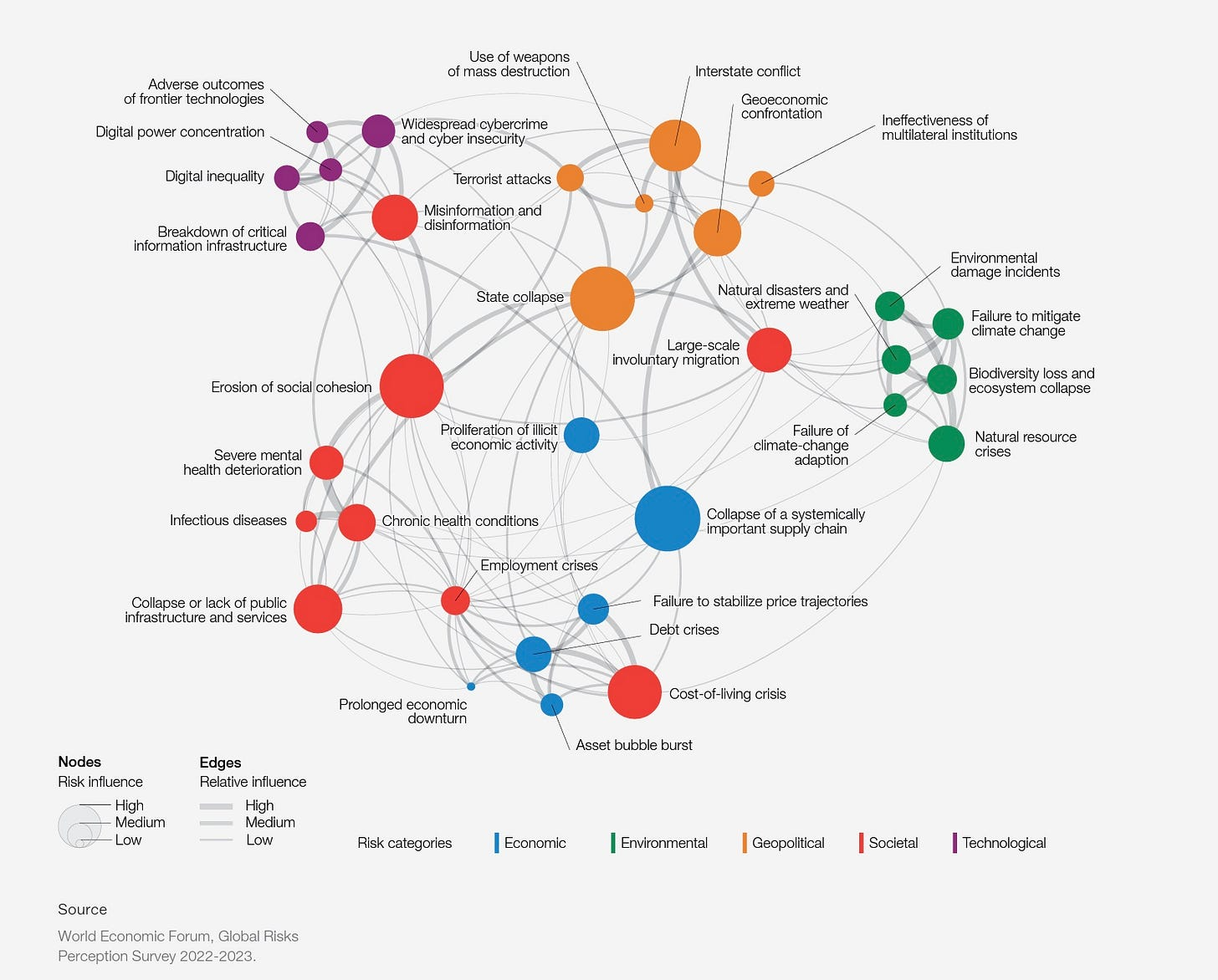
Several megatrends now overlap:
1. the climate crisis 2. the AI revolution 3. deglobalisation 4. the erosion of democratic institutions 5. Russia's war against Ukraine 6. the military conflict in the Middle East.
Eras are named by their outcome
The era of the 2020s will probably be named after its main outcome, not after the feelings of those who lived through it. The options depend on how it ends:
- Third World War
- Deglobalisation
- Pre-Singularity
- The Great Unraveling - a term already used by ecologists and defined as "the simultaneous disintegration of institutions, alliances, climate stability and informational consensus".
To guess what the 2020s will be called, let’s look at what people called their own era during World War I and World War II.
The First World War (1914-1918)
The Great War: the most widespread name in the English- and French-speaking world. It emphasised the unprecedented scale of destruction.
- The war that will end all wars: an optimistic (and, unfortunately, mistaken) slogan launched by the writer H. G. Wells.
- The term "First World War" was first used in the diary of Lieutenant Colonel Charles Repington as early as 19184. He predicted that this conflict would not be the last, and proposed calling it the "First" to distinguish it from the ones that would follow.
The Second World War (1939-1945)
The name "Second World War" began appearing in the press almost immediately, but it did not become official everywhere. Other names competed with it:
- The Big War: frequently found in the personal diaries and letters of the time.
- War for Survival: one of the names US President Franklin Roosevelt proposed as the official one, but it did not take hold as firmly as "Second World War".
References
- Economic Globalization's Polycrisis, International Studies Quarterly 68(2), sqae024 (2024) - https://academic.oup.com/isq/article/68/2/sqae024/7634048↩
- World Economic Forum, Global Risks Report 2023 - the polycrisis risk-interaction map - https://www.weforum.org/publications/global-risks-report-2023/↩
- Lawrence, M., Homer-Dixon, T., et al., Global Polycrisis: The Causal Mechanisms of Crisis Entanglement, Cascade Institute - https://cascadeinstitute.org/technical-paper/global-polycrisis/↩
- Repington, C. à C., The First World War 1914-1918 (Constable, 1920) - the earliest widely cited use of the ordinal↩
- Morin, E., Kern, A.-B., Terre-Patrie (Éditions du Seuil, 1993); English translation Homeland Earth: A Manifesto for the New Millennium (Hampton Press, 1999)
- World Economic Forum, This is why 'polycrisis' is a useful way of looking at the world right now - interview with Adam Tooze, March 2023 - https://www.weforum.org/stories/2023/03/polycrisis-adam-tooze-historian-explains/