Even without consciousness, the human brain continued processing language
1. Jacobian Space, or J-Space.
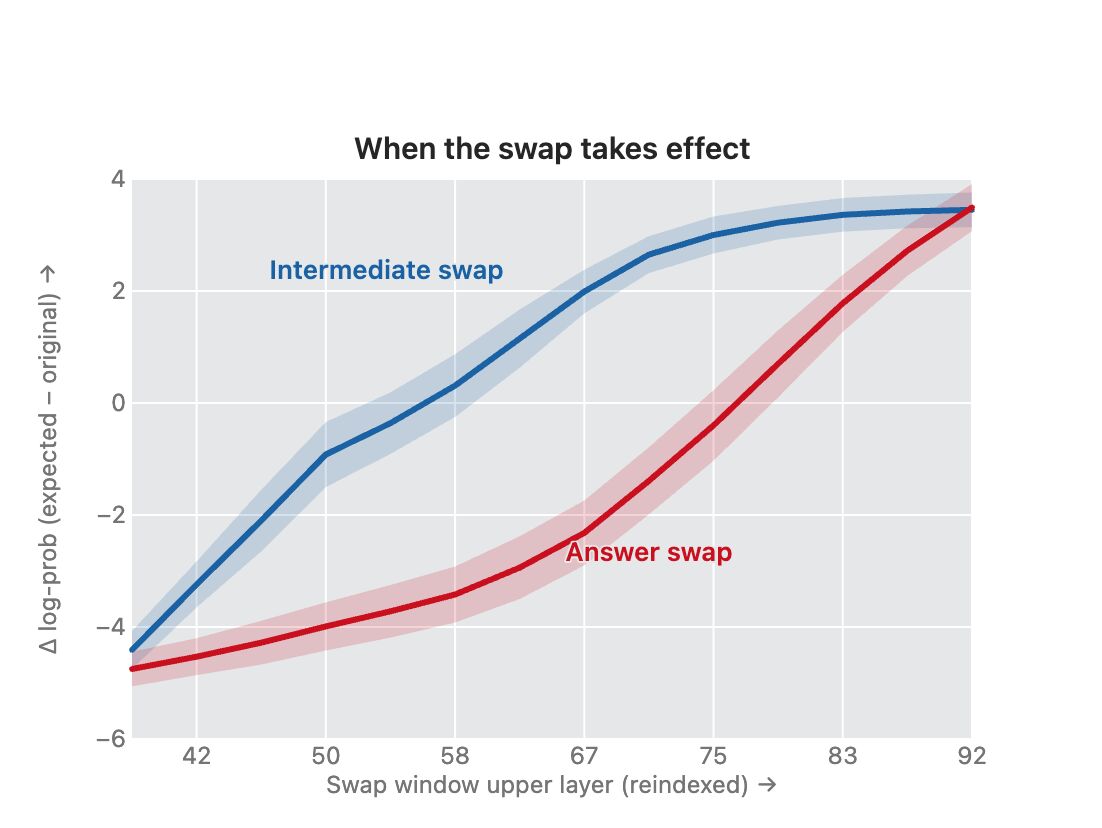
Anthropic engineers published the finding in July1: it turns out that AI models have a hidden space of reasoning, which they called Jacobian Space, or J-Space.
It is a separate space where independent abstract reasoning processes appear in the background of the network's activity. Unlike the chain of thought shown in chat interfaces, it is detected mathematically through the Jacobian matrix2.
In practical terms, it exposes concepts the model is processing without writing them out.
The J-space appears to support the functions associated with conscious access: it holds the thoughts Claude can report on, deliberately bring to mind, and reason with, while the rest of its processing runs automatically beneath.4
AnthropicInterpretability team, on the global workspace resultEffect of swapping a concept inside J-space, measured as the change in log-probability across layers. Gurnee, Sofroniew, Pearce et al., Verbalizable Representations Form a Global Workspace in Language Models, Transformer Circuits Thread, Anthropic, 2026. transformer-circuits.pub. Quoted under §51 UrhG.
What kind of concepts? For example, when you're trying to trick an AI, it may not show you this directly, but in Jacobian Space something like this may be running in the background: "Hmm, it looks like this guy is trying to fool me." Completely different thoughts may also appear there, with no connection to the model's current task.
So now we (probably) know that the answer to Philip K. Dick's question is yes:
2. LLM-like behaviour in the anesthetized human brain.
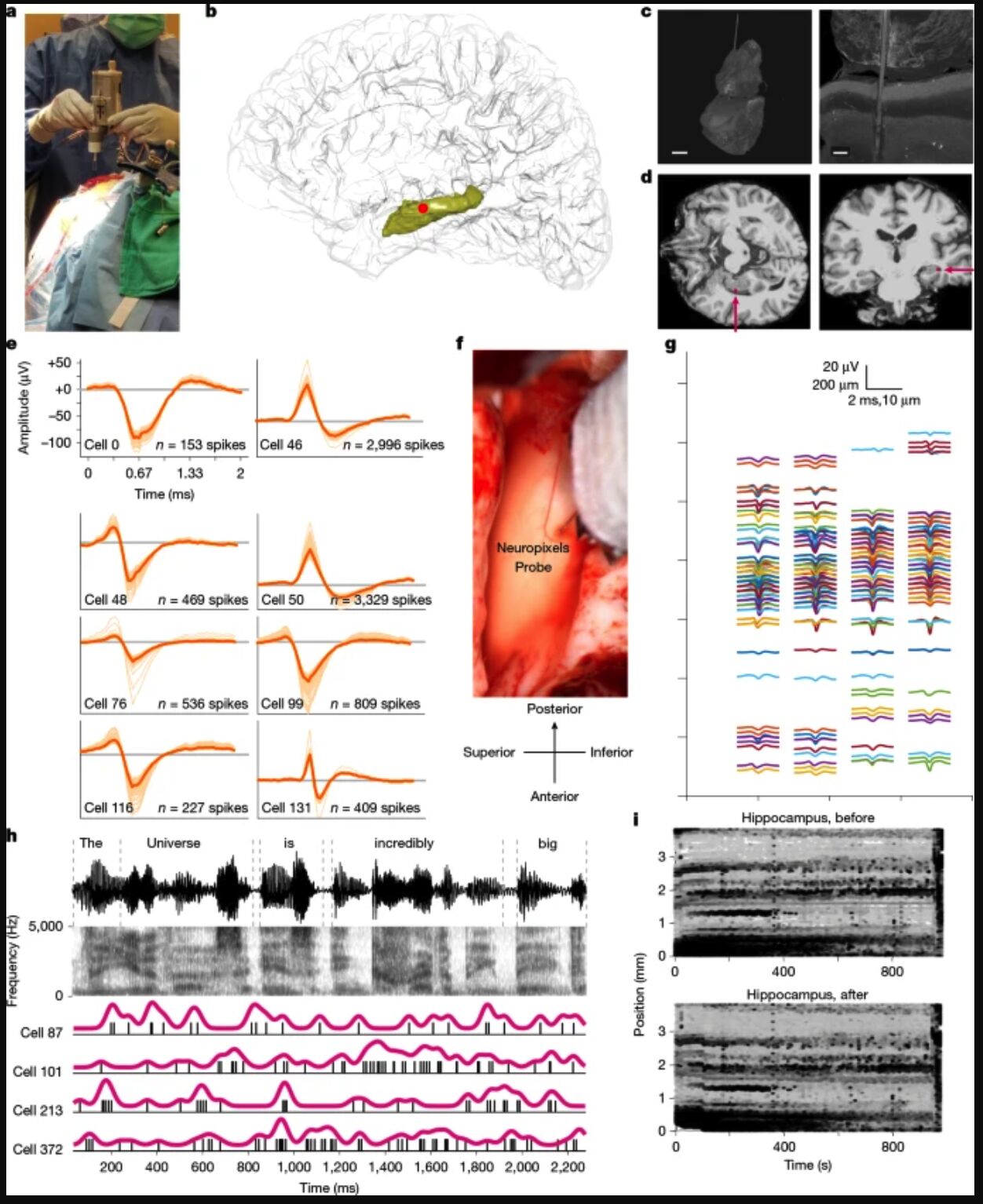
A research team from Houston studied the brains of patients under general anesthesia. While the patients were unconscious, researchers played them podcasts and YouTube videos and recorded neural activity.
They found something strange: even without consciousness, the brain continued processing language, tracking grammar and semantics and predicting upcoming words, much like an LLM's "next-token prediction".
The research was published in Nature in May 20266.
3Jacobi, C. G. J., De determinantibus functionalibus, Journal für die reine und angewandte Mathematik 22, 319-359 (1841) - where the matrix is introduced - https://doi.org/10.1515/crll.1841.22.319↩
4Baars, B. J., A Cognitive Theory of Consciousness (Cambridge University Press, 1988) - the original statement of Global Workspace Theory↩
5Dehaene, S. and Changeux, J.-P., Experimental and Theoretical Approaches to Conscious Processing, Neuron 70:2, 200-227 (2011) - the global neuronal workspace - https://doi.org/10.1016/j.neuron.2011.03.018↩